



Tools for Systems Thinkers: Systems Mapping
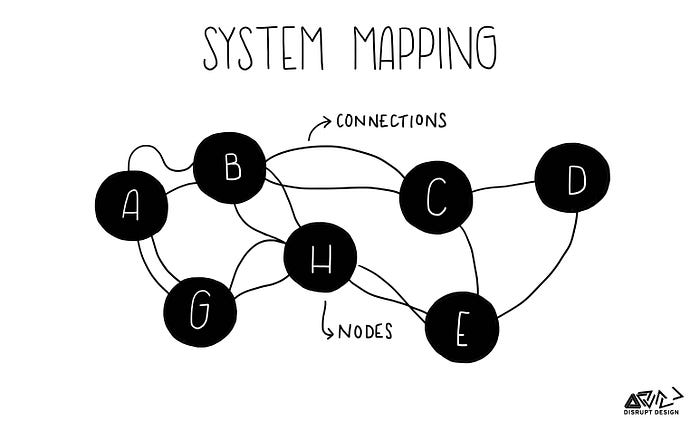
Systems thinking requires a shift in our perception of the world around us. In order to build a new multidimensional thinking framework, we need to discover the dynamics and interconnectedness of the systems at play. This is where systems mapping tools come in — they provide an exploration of the system, communicate understanding, and allow for the identification of knowledge gaps, intervention points, and insights.
As discussed in Chapters 1 and 2 of this series, I have been teaching systems thinking in relation to activated change making for years. While there are some great digital tools out there (like Kumu), every budding and experienced systems thinker will need to employ analog systems mapping tools as well. When I say ‘analog,’ I mean pen-and-paper style — no digital products — so get your writing hands ready.
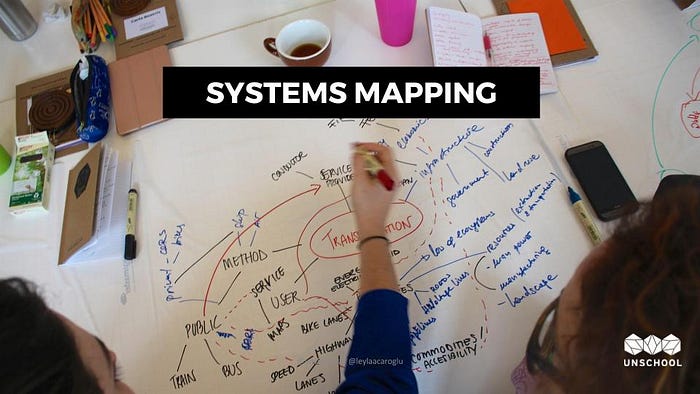
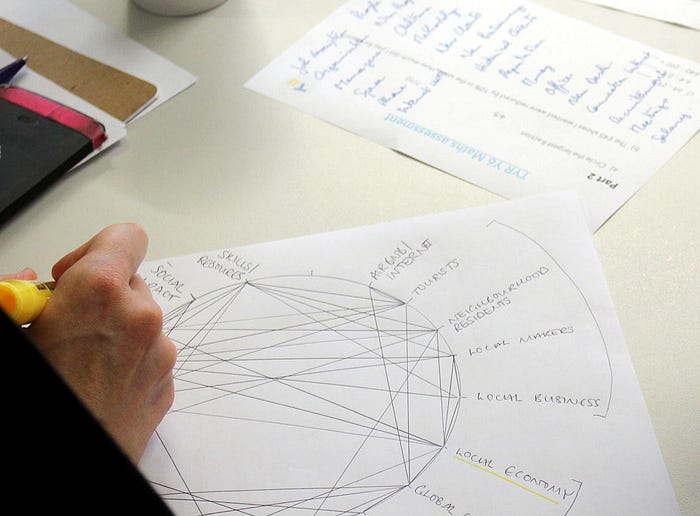
It’s funny how hard some people find it to get back to analog approaches. I have tested and refined these quick systems mapping tools, and use them constantly in my own practice, and with the UnSchool and Disrupt Design. I have tried to be as articulate as possible in explaining these approaches, but to be honest, I am usually explaining while people are doing, making it a very iterative learning experience. I would suggest that once you have read all of this, give a quick systems map a go to experience the discovery process first hand. Here is an example:
Map 1: Cluster, or, “Brain Dump” Maps
I always get people to start exploring complex problem arenas with a cluster map, or as I like to call it, a ‘brain dump’ map, which is what it feels like you’re doing.
It’s important to note that while similar, this is not a mind map. There’s nothing wrong with mind maps, it’s just the approach you take for a mind map is very different to the approach and objective of a systems map.
In a cluster map, we throw a topic, question, or arena down in the middle of a page, and then free associate nodes (elements within the system). There are no wrong or right words or ideas here, as everything is interconnected. We quickly move from one part to another, diving into an exploration of the elements that make up a system along with all the relationships and connections that feed into its maintenance.
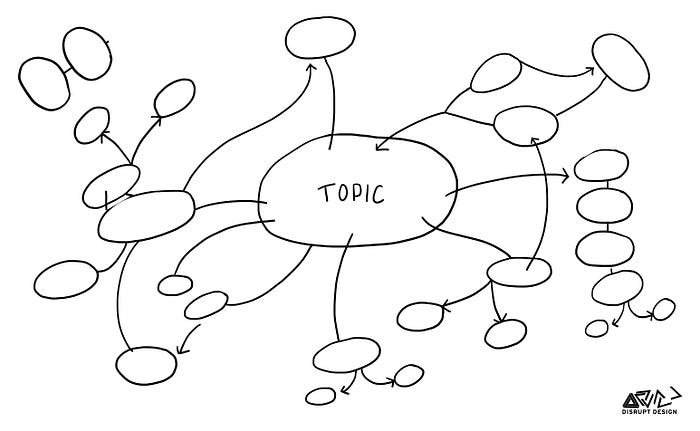
Once all the elements, agents, actors, nodes, components (whatever you want to call the parts you place on the page) are mined, the key part is drawing the connections and relationships between them. This is where you can start to tease out all the non-obvious parts and seek to develop a more complex view of the system you are exploring.
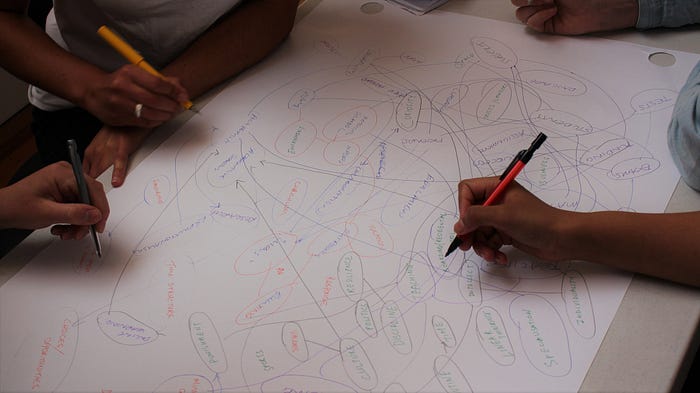
From this, insights can be drawn, and potential interventions points can be identified. While it may look simple (and it really is, once you get into it), I find many people get stuck and want to impose order on the chaos that is a dynamic system. So one of the key learnings here is to suspend the need to solve and embrace the chaos of the system. Relationships are messy, so the map should also be a complete mess. I encourage a the messier the better approach, as this shows that you have had one insight lead to another in your exploration of relationships and interconnections.
Another thing I’ve noticed is that many people feel the need to have a ‘right’ or ‘wrong’ answer to the exploration. However, cluster mapping is just that — an experience of exploration, trying to mine the collective knowledge of you and/or your team to find out what’s going on in the arena you’re seeking to understand or make change within.
Cluster mapping only takes a few minutes to do, and is a critical part of the Disruptive Design Method.
Here are the basic steps to doing a cluster map:
- Grab a large piece of paper and some markers/pens (different colors help, as you can start to use them to explore the different elements of the system).
- Start by identifying what you want to explore and writing it in the center of the page (this could be ‘education,’ ‘voter apathy,’ or ‘childhood obesity,’ for example).
- Make sure everyone working on the map has a pen (this is not a scribbling experience where one person writes what others say; it should be that all people are contributing to the map).
- Start to throw down everything that relates to the arena you are exploring (there is no wrong concept, word, or idea here — just free associate all the parts that make up the system).
- Once you have a page full of random works/concepts/nodes, then start to draw connections between them (here is where you can create a key and use different colors to define different flows, such as ‘power’ and ‘government’).
- Keep going until you have filled your page and it’s a complete mess or intermingled lines and words. Then, start to identity the key areas of interconnection and seek to define three new insights that have evolved from the exercise.
Once you have done a cluster map, you can move onto more detailed maps, such as Interconnected Circles mapping.
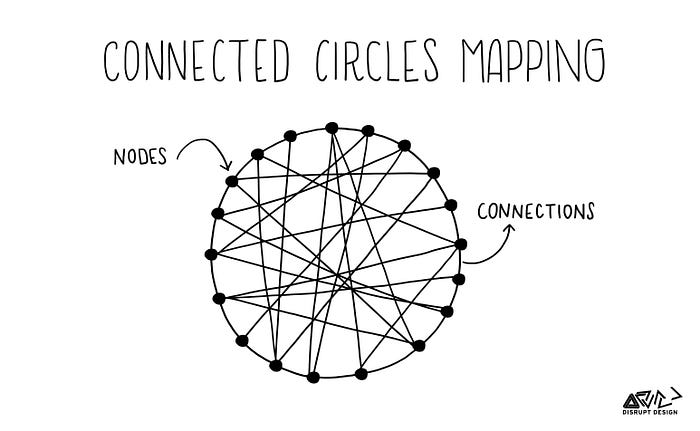
Map 2: Interconnected Circles Maps
Practicing systems thinkers know how hard it can be to get to the root causal relationship of a problem area, let alone define what the area of intervention is. I adapted the Interconnected Circles Map to help people think through and explore systems. It’s an individual map that allows for a deep exploration of relationships and cause and effect in systems dynamics.
This sounds way more complicated than it is. The map should empower you to see the parts and the whole along with the relationships. It enables a synthesizing of the key flows in the system, and provides a tool for enabling emergence.
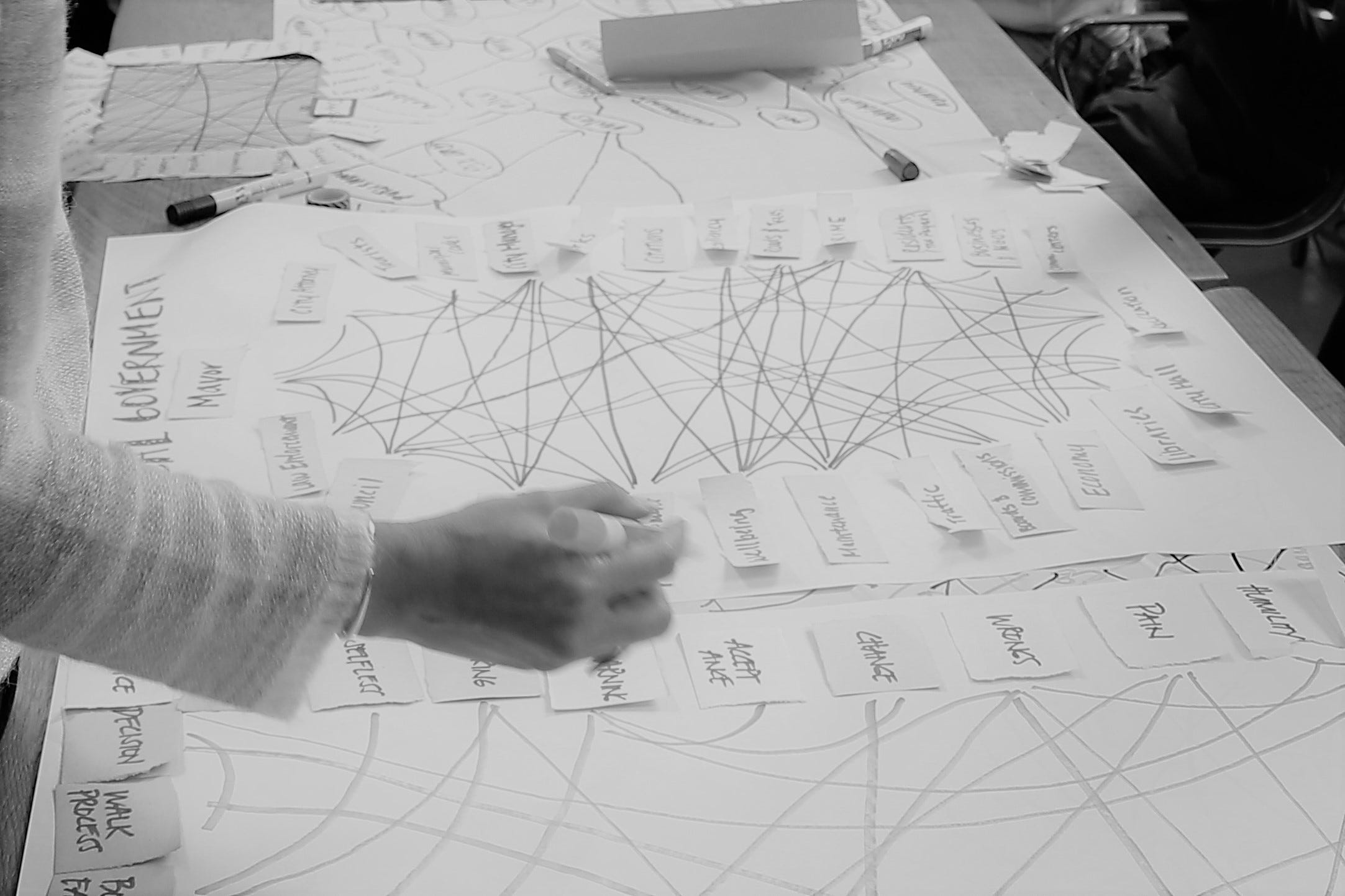
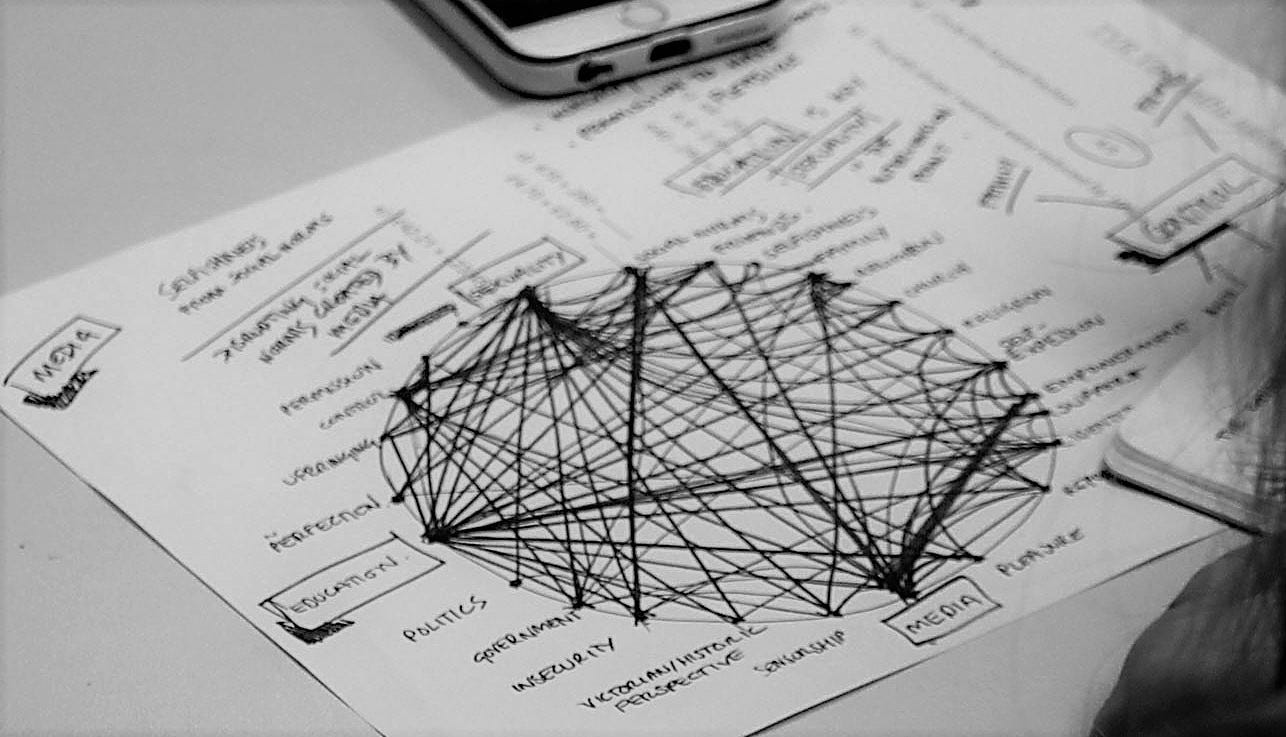
This is a great map to do on a refined area that you identify through your cluster map. Start with documenting all the parts of the system, and then cut or rip them up into little pieces of paper that you can move around. Get another piece of paper and draw a large circle. Next, start to place the small parts around the outside,allowing editing, movement, and synthesis.You start to draw connections between the parts, and through this, you will uncover dynamic relationships as well as identify areas of more relevance or importance for your intervention.
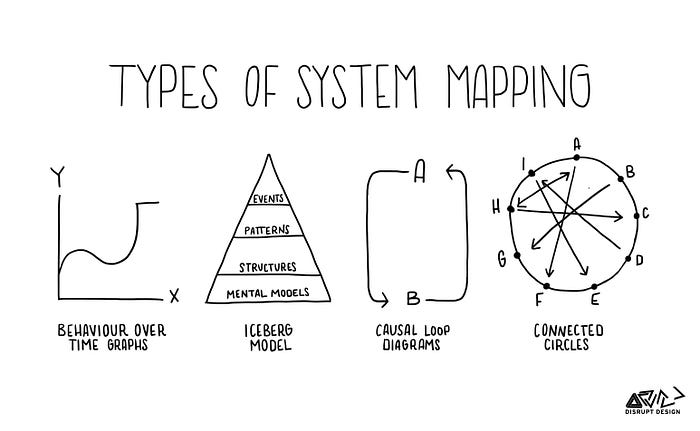
As a practicing creative change-maker, I use systems mapping tools like this all the time when I want to identify the divergent parts of the problem set and find unique areas in which to develop interventions. I also use them to gain clarity in complexity, and find it especially useful when working in teams or collaborating because it puts everyone on the same page.
These are just a few examples. There are many ways to map a system, such as behavior over time graphs, causality maps, and feedback loops. The latter is very popular as a way of explaining how a system works. I am specifically interested in applying systems thinking to problem solving and examining how it can lead to much deeper levels of understanding than a normal research or exploration process can — especially in design thinking, where the need to solve is often very strong. But, we need to understand before we can build. This is why systems thinking and mapping tools like this are fundamental to the Disruptive Design Method, and can also be easily applied to any creative problem solving objective.
In the next chapter, I will run through what systems archetypes are, and how to use these ‘rules-of-thumb’ to quickly identify complex systems dynamics and behaviors.
— — — — — — — — — — — — — — — — — — —
Looking for more on Systems Thinking? Join any of the UnSchool System Thinking programs, from short introductions to full classes.
I teach this stuff, and my team at Disrupt Design and I are always happy to help organizations get active in systems thinking